

Newsletter for alumni of The Abbey School, Mt.
St. Benedict, Trinidad and Tobago, W.I.
Caracas, 23 of June 2020
No. 972 extra
-------------------------------------------------------------------
Dear Friends,
This material was prepared by Jan Koenraadt,
interesting material on Mt. St. Benedict.
The words in italics are Jan’s commentary, while the plain text is his
translation of the originals.
--------------------------------------
This article is written in 1917 by Dom Wilfridus Broens O.S.B. at Mount St. Benedict, Tunapuna in Trinidad. [After Dom Mayeul de Caigny, Dom Wilfridus Broens was probably the prior of the Priory and did the founding work until he died in 1943. He was buried at Mount. After him came Huug van der Sanden who was the prior. The priory turned into an Abbey, and in 1947 Dom Adelbert van Duin became the abbot.]
This article is written in 1917 by Dom Wilfridus Broens O.S.B. at Mount St. Benedict, Tunapuna in Trinidad. [After Dom Mayeul de Caigny, Dom Wilfridus Broens was probably the prior of the Priory and did the founding work until he died in 1943. He was buried at Mount. After him came Huug van der Sanden who was the prior. The priory turned into an Abbey, and in 1947 Dom Adelbert van Duin became the abbot.]
The article is written in Dutch for a local
Dutch church magazine ‘St. Antonius Bode’ in August 1917 in the Netherlands.
The Netherlands were neutral during the First
World War, therefore this kind of communication between Trinidad and the
Netherlands was possible.
The article
is meant to describe to the Dutch readers what the Benedictine monks are doing
in the West Indies.
The
Mission of the Benedictines in the West Indies.
By Dom Wilfridus Broens O.S.B. at Mount St. Benedict, Tunapuna in
Trinidad, written in 1917.
When
St. Benedict lived with his first followers in a cave at Subiaco around the
fifth century, he was guided by Holy Providence in a special way to leave this
low-lying place. On
the crowns of Monte-Casino, there he would establish his order for good. Here he wrote his Holy Rule, where all the
beauty of his great soul has been worked out. His precepts, given in the fear of God, are
pleasing because of an admirable insight and extend to perfection and Christian
love. This work of great wisdom and
human knowledge also has this appeal, that it first and foremost prescribes
works of godliness and then allows free development of all gifts of nature,
both in the field of hands and mental labour.
According to the circumstances in which
Benedict's spiritual sons lived, they have been missionaries, writers, and
historians, teachers, and farmers.
Surrounding abbeys with schools and pilgrimage
houses, practicing the liturgy, the visual arts and singing, they have brought
civilization to the lowest circles of the barbarian peoples. Half a century after Saint Benedict's death,
his order had spread from Western to Northern Europe. About the end of the fifth century, the first
Benedictine missionaries from England came to the Netherlands to bring the true
faith. Many countries in Europe, but
especially the Netherlands, have enjoyed much of Saint Benedict's order.
As they up to now continue to work in Europe
today, so that God may be glorified in everything, in the same way they spend
their powers in the other parts of the world. In North America they have great foundations
with many mission parishes in the United States, in Canada and in Mexico. In
South America they have colleges, schools and extensive missions in Brazil and
Argentina. In Australia they have done a
great deal for the arrangement of the Church with missions on New Zealand and
the Philippines. In Asia they work with
great success on Korea, in China and Japan, on Ceijlan (present Ceylon or
Sri Lanka), and in Palestine. In
Africa they have penetrated from Algeria to the Congo state and Zanguebar (present
Zanzibar), to Transvaal, and Natal.
In Central America they have started a new
mission work on Trinidad, one of the main islands of the West Indies. A little more about this mission.
Due to the great shortage of priests and
monastics in the West Indies, our High Reverend Government decided to apply for
a foundation on the island of Trinidad. Gladly,
His Serene Highness, the Archbishop of Port of Spain, gave permission. A piece
of mountain land, eighty hectares in size, was purchased from the government. The plans would then become action. October 6, 1912, the first missionaries, two
fathers and three brothers departed. They
built a small auxiliary church and a house; soon many visited them, whites,
coolies, and negroes, some of them out of curiosity, others to seek Jesus
Christ in his humble home. (Coolie is
an obsolete and now offensive English term for an unskilled Indian labourer. The
word is found in both the Hindi and Urdu languages in the sense of an unskilled
labourer.). The assurance of the
started missionary work was that several conversions were taking place, even of
Protestants. Among the newly converted
are also young men and that is a very joyful sign. They are often seen at the Communion rail,
despite the long distances they have to travel in the early hours of the day.
The influx of believers was so great that a
larger auxiliary church was built twenty-one meters long. More helpers were
also sent. Some of these are active here
in abandoned parishes, others are ready for new parishes in the making.
The joint relief buildings of the main
foundation are located on the crown of a mountain called Mount St. Benedict,
two hundred meters above the ground floor and twenty minutes by rail from the
capital of Trinidad, Port-of-Spain.
The second goal is, besides the proclamation of
faith, to establish an agricultural colony and craft schools for the West
Indians of Trinidad. The government
fully recommends this endeavour. Crafts
should also be learned by the coolies and negroes. What does it usually give, if they become
Catholic and stay lazy and not used to work? In their doing-nothing their persistence is
often unsteady. The experience teaches
it. Laziness is not always the cause of
their little work.
There are those who want to work, but who know
their trade so poorly that they are necessarily out of work. Craft education is therefore very necessary. They must also be preceded in agriculture. They say nothing grows on those high
mountains. Fortunately, we can already
give an example of this. Since these few
years, we have been working on the reclamation of forest mountains. We already have cocoa and coffee plantations,
cotton and bread trees, which will provide sufficient fruit. Orange and lemon trees, mango and banana trees
begin to rise along the roads in the hillside yard. Tender green pastures and corn with long,
thick ears are proof of the suitability of the mountainous areas. Agricultural experts who visit us are amazed
at what has been accomplished here in the field of culture in such a short
time.
As soon as we have enough craftsmen who want to
cooperate, not for a Saturday-wage but for a heavenly wage, the vocational
schools will start. To meet that need, a
novitiate has also been opened here for students and brothers. This novitiate has these advantages that the
newcomer student and brother become accustomed to the climate more easily, as
they are usually still young and do not have to make long journeys at once. They can effectively prepare themselves for
mission life. They learn the necessary
languages almost by themselves and they provide services to the mission early
on.
Eight Dutch people are already working, six of
whom professed. In addition to four
Brothers from Europe, we have five more natives, including gentile converts,
who live together with us as regular Oblates and are examples of godliness. There are also two natives among the students.
If we can continue like this, after a while it
will be possible to start on other islands of the Antilles and on the Dutch
possessions in the West. In Suriname,
the desire for such a foundation has already been expressed.
May this civilization work grow and flourish in
the glory of God and the development and salvation of the West Indians.
D. Wilfridus Broens O.S.B.
Mount St.
Benedict,
Tunapuna
(Port of
Spain)
Trinidad, B.W.I.
P.S. If
it is going to be a little bit good, then we have a great future here. Here too there is a very shortage of good
priests. All Dutchmen from Bahia have
moved here. Trinidad is English, but
there is also a lot of French and Spanish spoken. Let your Mission sisters learn languages,
especially English, because they are very useful. Spanish is widely spoken in these regions. Since we have learned Portuguese, we now learn
Spanish more easily, there is only a small difference. English is the main language here.
Our mission is progressing well, and if we had
more fathers and brothers, it would be even faster. Therefore, if you Reverend sometimes have
suitable youths for as student or brother, we will gladly accept them; we will
soon be with at least ten Dutch people. We have classes for secondary and higher
education, where besides our Dutch also some white people from the island take
lessons here.
Willing to inquire,
Your Dw*. Servant in J.C.
D.W. Broens
*Dw =
dienst willige = willing to serve
-------------------------------------------------------------------.
The following article was written in 1934 by
Dom Wilfridus Broens, O.S.B., at Mount St. Benedict, Tunapuna in Trinidad. It is written in Dutch for a local Dutch
church magazine ‘St. Antonius Bode’ in October 1934 in the Netherlands. The article is meant to describe to the Dutch
readers what the Benedictine monks are doing in the West Indies.
The Benedictines Mission on Trinidad.
By Dom Willibrord OSB, Procurator, written in
1934.
From
a Catholic point of view, one cannot deny that the last page of Trinidad's
religious history fills the heart with nostalgia. Once so solemnly devoted by the world
discoverer Columbus to the most holy Trinity, this island actually belonged to
her. The zeal with which the Catalan
Capucines once undertook conversion work here, as well as the strong cooperation
of the Catholic Spanish government, had made it into a literal Catholic colony
in the literal sense of the word, of which - as we have already noted - no
other religion was tolerated; one now finds a mosque in the capital Port of
Spain, and a number of pagan pagodas scattered throughout the island, where
Siva sits on the throne. In addition,
there are all sorts of religious societies among the Negroes who honour various
pagan ceremonies from the Congo. Christianity itself, in the numerous sects who
constantly fight against each other, shows a sad picture of division, so that
the benevolent pagans wondering on which side the truth may be found. The Catholics have been reduced to a minority.
One can therefore safely speak of a
"recapture" of this delightful paradise for our King Christ. That is the field of work that our Benedictine
monks saw themselves assigned by God's Provision. Which role is reserved for them there? What will their share be in this conquest
work?
Before answering these questions, we first want
to become acquainted with the past and the development of this undertaking. The Priory of the "Mount St.
Benedict" is a foundation that originated from America's oldest
Benedictine abbey, namely "Bahia". Like several other monasteries of the
Brazilian Benedictine Congregation, this venerable foundation was founded by
Mgr. Gerard van Caloen recovered from her decline. The vocations, mainly from Europe, reported
numerous times under God's blessing that people could soon start thinking of
finding a new field of work. Attention
was paid to the West Indies and soon the Abbey succeeded in finding a suitable
place for the implementation of its plans in nearby Trinidad. This has indeed been chosen excellently. Located in the north of the island, on the
southern slope of the beautiful green mountain range, which protects it against
the ocean, it dominates the fertile lowlands from its 250 meters. In 1912, on the feast day of Our Lady of St.
Rosary, the first Benedictine monks landed on Trinidad. Soon they took possession of their new domain,
which has since been called "St. Benedict's Mountain". The beginnings were modest. They found nothing but tropical wilderness. In a pitiful dwelling, or rather a hut, they
began their missionary work, after ancient Benedictine custom with the
liturgical prayer of the God, God blessed these first attempts. The mountain, which leads up to the sanctuary
in a zigzag way in thirteen turns, did these Benedictines realize at that time
the important consequences that this disposition would have for their action? Who was keen to show her interest by
following the progress of this work with sympathetic curiosity, which also laid
the foundation for a favorable contact. It
did not contribute much to making the Benedictine Foundation popular.
The road to Mount St. Benedict was now known,
and the ancient Benedictine hospitality did the rest. The monastery soon became a beloved place of
pilgrimage, attracting pilgrims of all walks of life and age, pagans as well as
Christians of different religions. They
come there to unite with the choir prayer of the monks. They confidently ask St. Benedict for his
mighty protection, while they ask the fathers for advice, information and
prayer.
In the year 1915 this young foundation was
founded as a Benedictine priory, His High-quality Excellency, the Archbishop of
Trinidad, who soon realized the significance of this foundation for his people,
and soon sought the influence of the monks in wider circles to serve. That is why he entrusted them with the care of
San Fernando, the second city of the island, with a population of 40,000 souls.
Various Protestant sects develop a very
large activity here, especially in the field of education, bearing in mind the
principle that who has the child, has the future. That is why in addition to the parish church,
the Benedictines also opened a gymnasium, which is already visited by about 70
pupils, and is highly regarded by the population.
At the request of Mgr. J.P. Dowling, the
Archbishop of Trinidad also entrusted the monks with the mission on the island
of St. Vincent in 1919. Here you can
still find tribes of the Caribs, who were driven out of the other islands, who
managed to survive in the midst of the mountains. They must still be won for true faith.
Moreover, there are 50,000 inhabitants on this
island, of which 5,000 belong to the Catholic religion. The hurricanes on this island often keep a
terrible house, so that the poor churches that were erected there were in a sad
state. The priory sent two monks here
for the time being, who had already achieved many good things.
This is in a few aspects the work program that
the priory is trying to realize. I write
"try" because, when considered, it surpasses the forces available to
it. So far it only has thirteen priests,
a far too small number for such a multifaceted undertaking. But the demand is so great that it is weekly
an art to limit itself.
But apart from this activity, which can finally
be granted by any other spiritual society, I would like to ask whether these
monks, in their capacity as Benedictines for this population, are of any
particular significance?
Saint Benedict gave his sons the "Opus
Dei" as their main occupation. One
of their main traits is a life dedicated to the praise of the Lord. In his famous mission encyclical, our Blessed
Father has unequivocally demonstrated to the Pope the importance of which he
considers the establishment of such monastic societies in the mission area. This was already expressed as his dearest wish
by the deserving restorer of the monklife in Brazil when he wrote to his Abbot
in 1889:
"Consider how it would be beautiful and consoling,
for the Church, that for us, to see your holy Order gradually taking root in
many countries, where it is absolutely unknown and to become one of the main
forces of the. Church, to train indigenous clergy there and to re-worship
divine praise, which is impossible for ordinary missionaries."
As such, the priory of Mount St. Benedict may
no doubt be assured of fulfilling a message which will bless the people of the
island and far beyond. All the more so
since it is the only one of its kind in the Antilles so far.
But no matter how important this Opus Dei may
be to the environment Benedictine life also contains other elements that are of
no less value to this society. The
purpose of St. Benedict's legislation is no different than to realize the ideal
of Christian life according to its supreme form - namely on the basis of evangelical
councils - as faithfully as possible. But
this realization is not so much thought of as an individual, but rather as a
social one, because he gave the character of a family to his monastery
community, with a father as head. Finally, in this way of life, her public and
official character is striking, which is evident to the fact that thanks to his
spirit of charity and hospitality the holy lawgiver demanded that his monastery
should not only be open to fellow brothers, but also for all strangers, rich
and poor, who would knock at the gate. They
are not only allowed to share the meal of the monks, but also to conform to the
example of their lives. It is these
character traits that, from time immemorial, made the order particularly
suitable for the mission which it had set aside in the establishment of a new
Christian civilization in Europe. They
are no less suitable for the social conditions that the monks of Mount St.
Benedict have found in their field of work.
The latest history of Trinidad has already
taught us that we are facing a major but complex problem in the social and
religious field. We find here a young
society, mainly consisting of a population, who hardly came to settle there a
century ago. Rarely have people seen
such a wide variety of races, peoples and religions within such limited
boundaries. In the interest of the
inhabitants, however, it seems desirable that in the long run a fusion will
grow out of all these heterogeneous components, so that the bond of solidarity
will be tightened more closely. This is
all the more ideal, because on an island people are more dependent on each
other.
Click on this
link to get to the original article.
January 2020: A translation with Google Translate by Jan
Koenraadt
------------------------------------------------------------------.
EDITED by Ladislao Kertesz, kertesz11@yahoo.com,
if you would like to be in the circular’s mailing list or any old boy that you
would like to include.
-------------------------------------------------------------------
These are
the photoshopped photos in the Essay:
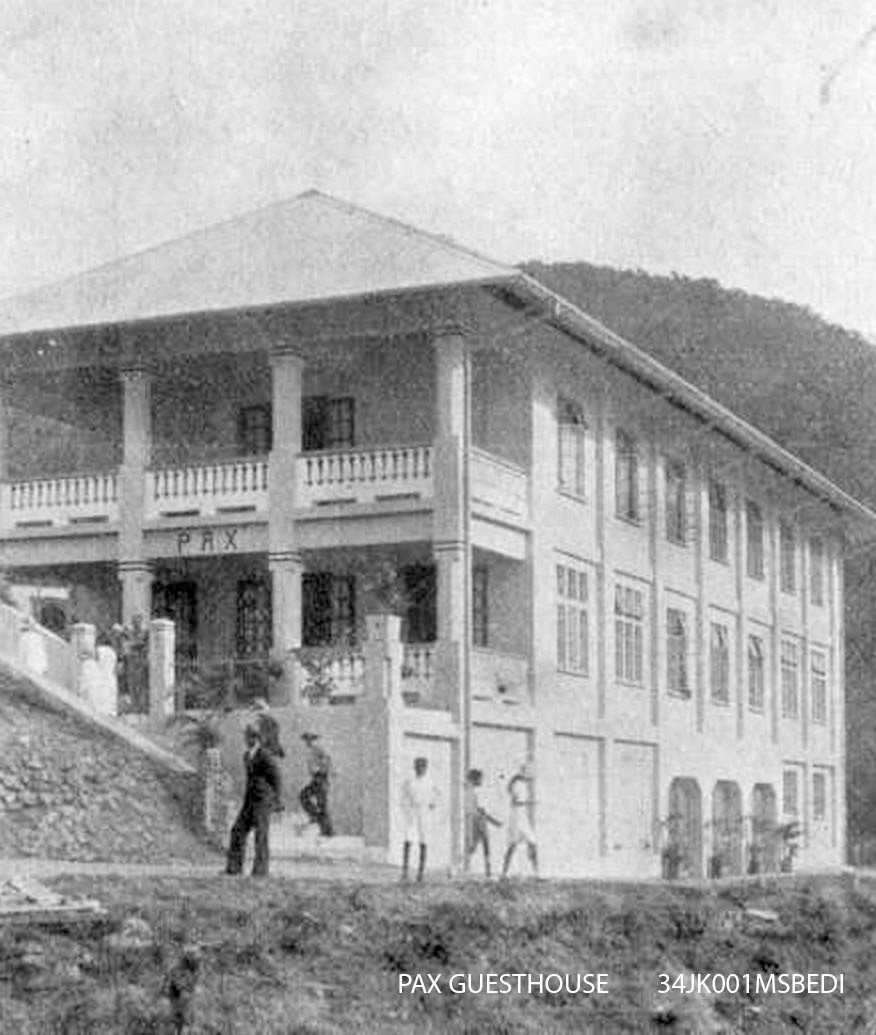
34JK0001MSBEDI,
Pax
34JK0002MSBEDI,
Bede
34JK0003MSBEDI,
Passageway old and new monastery, photo taken from the bell housing.
34JK0004MSBEDI,
Church
34JK0005MSBEDI, Lab


